Tuesday, 12 February 2013

'Looking For Harvey Rose' - the short story.

For my creative writing course, I was tasked with producing a genre piece in under 350 words. This caused complications for me, as I think to limit an writer to what is "necessary" to their piece is anti-intellectual and anti-artistic. However, it proved to be an assignment that provided me with insights into self-editing. The genres offered were romance, crime and western; three of my favourite genres. However, as I practically breathe gangster films (or that might just be the marijuana vapour convincing me I'm a G) I chose crime. Because I'm taking advantage of the course for my own means, I chose to use the character from a script I'm writing, the titular Harvey Rose. (No relation to ASSP's own Harvey Slade, obviously, because one does not convey family ties through the first name, apart from in North Korea. And we all know shit's a bit funky up in there.) Anyway, here it is. It's still not quite under 350 words.


“Our boys found a .44 Magnum at your place. What kind of a hippy are you, anyway?”
“Hey, man, I’m a hippy. I just had to pack a gat sometimes to get where I am today.”
“Yeah,” cracked Lieutenant O’Donnell, “...a fuckin’ prison cell.”
It had started, as so often seemed to happen to Harvey Rose, when his door was kicked in. This time it was the cops. Harvey’s dictum was that familiarity breeds not contempt but comfort. He sat stolidly as they fired easy questions at him, thinking, there’s nothing so daunting about the tank if you’ve been in there before; once, twice, a dozen-odd times since the pop revolution.
“Then there’s this heavy, got his ass mown down ‘side some party in Topanga two years back. Seemed like your garden-variety worthless piece of criminal shit, but he worked for none other than Vitale Danza, so perhaps he wasn’t without talent.”
“Just checked the file, Joe” the cops were doing their routine, “and Timothy “Rattlesnake” Conway had a preternatural gift for cocaine trafficking.”
“Don’t know no Rattlesnake,” Harvey grunted.
“Ain’t that just some shit, ‘cause, hypothetically, we knew who shot him, we could stick his ass in stir.”
“See where we’re goin’ with this?”
“As it happens, we’ve been looking for a hook into the Danza organisation for some time. Now, if he ain’t fuckin’ killed you yet, that implies to me that he ain’t fuckin’ gonna...”
“It’s funny...it’s almost like,” Harvey laughed in too high a pitch, “you want me to flip?”
You could hear it from the booth; even the coldest narcs, guys who hadn’t cracked a smile since Kent State, broke out in laughter. The lieutenant wiped his brow and spluttered, “We laugh now, but that is the idea, yes.”
“Hell, fellas, you got the wrong guy. Check your garden, I probably landscaped it. I’m straight.”
The lieutenant had been pacing, but at this he sat opposite Harvey.
“Only been 18 months. And it was gradual. Six months prior, you murdered Rattlesnake Conway. Why? I could give a fuck. He was a louse. It took you half a year to make good with Danza before you could get outta the game.  How hard’s it gotta be to make a comeback?”


Tuesday, 5 February 2013

John Ford: A True Western Villain

Quentin Tarantino's wonderful new epic, 'Django Unchained' has been extraordinarily successful since its domestic release on Christmas Day 2012. This should be no surprise; it's directed by Tarantino, arguably the world's most popular straight-up auteur, and stars big box-office draws Jamie Foxx, Samuel L. Jackson and Leonardo DiCaprio. Yet, 'Django...' is atypical in today's mainstream cinematic landscape in several ways. Its comedy and movie-violence is juxtaposed with a brave depiction of the horrors of slavery; where the viewer delights in Tarantino's trademark violence as ignorant slavers are whipped and shot by the man once bred to fear them, when two black men are forced to fight to the death for the entertainment of their master, the film becomes almost impossibly brutal. It's shockingly rare to have Afrocentric blockbusters, beyond Tyler Perry's cross-dressing Christian propaganda, least of all ones that are so candid about one of the darkest chapters of American history. It's a nearly three-hour film, and an ambitious and unconventional work, with the writer/director continuing to use decades of pop-culture as the palate that colours his stories. 'Django Unchained' is an anomaly as a hit film in 2012/13, because it fits fairly perfectly into the time-honoured Western tradition.

"Time to murder some underwritten characters because of their race!"

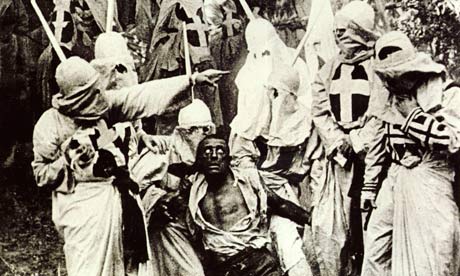
I hadn't seen any John Ford until recently, when I saw 'The Searchers' in my Film Studies class. Although he is supposed to be the King of the Western, my only prior knowledge of his work had been a Quentin Tarantino interview I read around the time of 'Django's', where he was asked about his favourite Western directors. He cited Sergios Leone and Corbucci as key influences, and explained that he hated John Ford, principally because the celebrated director had a substantial (but uncredited) role in D.W. Griffiths' 'Birth of a Nation' as a Ku Klux Klan member. There is no need for me to explain how much hate and violence that "classic" (read; worthy of some Nuremberg-style litigation) film created. I've had people argue to me that Ford was a product of the era, and his environment, but I think that's bullshit. If you're intelligent and compassionate enough, you know the KKK are evil, regardless of whether or not 'The Clansman' was a big-selling book at the time. Charlie Chaplin didn't spend 1915 lending his talents to racist films that promoted the murder of black people. Years later, he was practically kicked out of the US for being too left-wing. People's ideologies are their ideologies.

"I never liked John Wayne films. Sexist and boring. xxx." - a text from my mother.

So, I saw 'The Searchers' and thought, though the film was artistically beautiful, the script was a crock of shit. It starts off with caricatured, "scary" Indians, devoid of emotion and personality, committing a basically inexplicable act of atrocity, which serves to justify John Wayne gleefully shooting them down for the next two hours. Then there's a scene that can only be described as some STUPID-ASS SHIT, wherein Wayne finds some white girls in a Native American camp, and it's implied that the entire tribe has taken it in turns raping them. They just sort of stand there gurgling. It's extraordinarily moronic. The least sexist thing about the film is that one of the female characters can read better than her male counterpoint.

Prior to my viewing of the film, I asked my lecturer why he didn't consider 'The Good, The Bad & The Ugly' one of the quintessential classics of the Western genre, and he implied that it was too trashy and violent. I think that's an extremely elitist view to take considering its level of influence on modern cinema, and I maintain that Leone's 'Dollars Trilogy' are markedly superior films, particularly in their resolute lack of Ford's ugly, patriarchal form of good ol' boy White Supremacy. Wayne's character is definitely a racist, but I've heard people argue that the film isn't. You can blame it on its time, but 'Casablanca' didn't have a dumb script, and that came out 14 years beforehand. Whilst screenwriting was not a talent Ford possessed, his choice in screenplays reflects his personal tastes and views. Judging from what I know of his work; they were abhorrent.

Friday, 25 January 2013

Religion Poisons Everything: An Ode to Christopher Hitchens

Society is already poisoned; it has sipped the Godly chalice for as long as it remembers and birthed its young in the middle of mass. Given a world of stained glass windows to stare at, we're taught to focus on the pretty pictures, until some begin to look for the reality hiding in the light behind them. But we should never be born in the Church to begin with.

That's precisely what modern society is - a giant Church. We can sit in the pews, chained like Plato's prisoners, and discuss what we like, but there's always going to be a home advantage given the unfortunate location for the debate. Modern day conceptions of 'secular society' are quite frankly impossible, because religion is so deeply ingrained in society that it's become the norm - a hidden norm that people refuse to accept as being there.

Let me qualify all this with an example: if someone were to propose an 'atheist' school, perhaps on Gove's free school scheme, society at large would laud the idea as a 'stupid, militant atheist' attempt at putting religion down, like religion is some poorly picked on child that means well, but just needs the other mean kids to leave it alone. We get it, you don't believe in God! Just stop shoving it down our throats please. Right?

This is not the position - religion is the bully. For centuries atheists and blasphemers would be stoned for not towing the party line, but now that this has (largely) stopped we're supposed to see religions as some harmless little book club in a respectful, pluralist society that will treat all points of view with equal credence. But we have hundreds of faith schools in the UK that attract no attention whatsoever. When a new faith school is proposed, there is no backlash saying 'MILITANT CHRISTIANS! What a mean attempt at putting atheism in its place'. As I have said, we are born in the Church. We're born into a world that intrinsically and seemingly unknowingly puts religious views on a higher plane than non-religious ones.

Everything we see has its religious tint, shining through from those seemingly harmless stained glass windows. The world we live in was built on religion and now its walls reek of scripture and bias. Even a pluralist society is completely inconceivable because there is simply no way that all points of view can be fairly and equally respected. Parents, themselves not particularly religious, still continue to baptise their children, you know - just in case, or perhaps go to Church to instil their child with basic values. The fact that these concepts are even acceptable is just blatant evidence of the religious skew that exists so innocently. Overnight religion has become a harmless collection of book clubs who have some nice stories to teach you a thing or two, rather than the man whispering in the executioner's ear.

If I go out onto the street tomorrow and hand out leaflets with lyrics to John Lennon's 'Imagine', telling people to forget about God and the afterlife and just enjoy the ride, I'll be lambasted as disrespectful and pompous and basically like the bad older child going round shouting that Santa Claus doesn't exist. But religious groups do this every day, granted not with much interest, or maybe not even that much respect - but it's accepted. You're not surprised when you see it, you're not offended and it's fair enough that someone's extolling their own values onto others.

You might say that atheism is an absence of religion, and thus extolling its values is paradoxical and thus must be in some way pompous and disrespectful. But whilst to be atheist may be a negative, in this case a negative is required - because we live in a society with the positive religion thrown at you from all directions. Heck, atheism should always be the first stage of thinking when it comes to philosophical ponderance on the issue of God. Why would you be born assuming that there's a God, and then if you wish to challenge this notion then go ahead - but the starting point is that he's there? We should start by thinking there is no God, and if you can reason one from there, then fair enough. But instead we live in a Church where he's put all around us to begin with, and those who choose against a religious life are expected to sit quiet through the mass, while the rest of us start faith schools, societies, pressure groups and street-stalls.

'Secular society' my balls.


Harvey

Wednesday, 26 December 2012

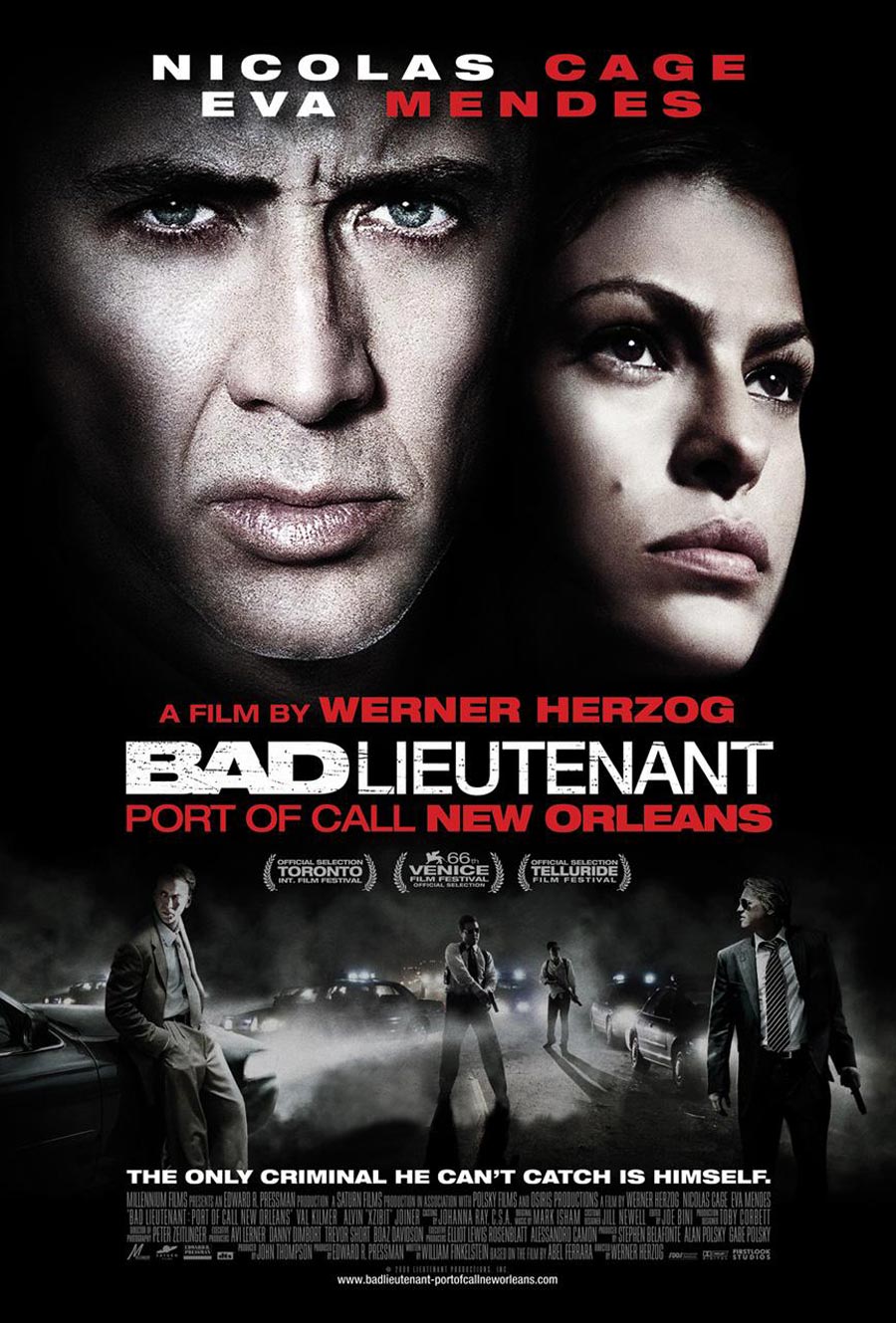
Film of the Week #1 - 'Bad Lieutenant: Port of Call New Orleans'

"What are these fuckin' iguanas doing on my coffee table?"


The roles Nicolas Cage takes often require a certain unhinged quality that is no doubt influenced by his own eccentricity. Thanks to memes and YouTube compilations, Cage's most batshit moments have won him a cult following; equal parts admiration and mockery. Each film he's involved in, whilst frequently being awful direct-to-DVD bullshit inexplicably cooked up within the studio system and serving to pay off his enormous debts, will provide some classic Cage, whatever the overall artistic quality. Nevertheless, the actor's fans (of whom I am certainly one) believe that he works best when paired with a director in possession of a singular vision.

There are directors with a singular vision. And then there's Werner Herzog.

Herzog uses William Finkelstein's script as a sort of loose framework for his trippy vision of a man's descent into drug-fuelled madness in a decrepit, post-Katrina New Orleans. The city plays the role of the other main character; its ruined beauty ever-emphasised by Peter Zeitlinger's unsettling cinematography. Cage's Terrence McDonagh is a tyrant, but New Orleans never concedes him the control he'd like to exert.

Finkelstein's dialogue might seem kind of wooden on paper. I can't imagine "mind if I light one up?" bears the same neurotic comedic weight as when delivered by Cage, and I'm unsure as to whether the classic "oh yeah" guy could conceivably have been scripted outside of the surreal environment of Herzog's New Orleans. The director's authorial mark is unmistakable, particularly the tour-de-force of filmmaking that is the (I believe unscripted) scene in which Cage, tripping absolute balls, walks in on a surveillance operation and notices aforementioned "fuckin' iguanas," before the plot is sidelined as a soulful slow-jam kicks in and Herzog cuts to the iguanas' point of view, flittering between the two animals' lines of sight with heavily impressionistic camerawork, Cage staring on in the background in suspicious wonderment.

It's a nasty film. Cage's character does all sorts of horrible shit, and mostly gets away with it; pulling out an ailing old lady's breathing tube ("Maybe you should just drop dead, you selfish cunt. Sucking up your family's inheritance through that fucked oxygen tube!) , having sex with a young woman in front of her boyfriend in return for lack of conviction for the crack cocaine he just stole from them ("Where the rock at? C'mon, who's got the kibble?!"), abusing his power by doing nothing at all as Xzibit's crew ("G! Hahahahaha!") dump a suspiciously corpse-shaped package in the river. He's crippled for life from one time he reluctantly did a good deed, and fuck is he compensating for it. Now he has an economical attitude to the law, evidenced by the fact his girlfriend is a prostitute, with whom he bonds over Class A drugs. She's played by a perfectly vulnerable and, yes, sexy Eva Mendes. But when it seems like it can only go downhill for Lt. McDonagh, every single subplot is resolved in a hilariously lazy fashion.

That's not a spoiler. Bad Lieutenant's not about plot. There is one, primarily concerning a murder investigation, but it's incidental. While life changes around Cage's character, he stays the same; a drug-addicted asshole mess. Herzog says the film is about "the bliss of evil," and people brush the cop's evil under the carpet, or enable him, or don't notice. There are extraordinarily tender moments of sadness, hope and pathos with his wreck of  family, jarringly juxtaposed with his frenzied, gut-bustingly funny madness as Cage's remarkably accurate imitation of drug abuse evolves to reflect the uncut crack that comes into his possession somewhere along the line of the non-plot.

Some could interpret this film as a gritty crime thriller, but by the time Cage is staring ecstatically at a dead man's soul breakdancing to a jaunty harmonica tune, it becomes pretty obvious that it's simply one of the most absurd comedies ever made, in the greatest possible way. I urge this blog's reader to get their hands on this film immediately. Once attainment is accomplished, get the kibble, sit down with your lucky crackpipe, and light one up!

Saturday, 17 November 2012

Notes from my memoirs.


#1
Leaving London
“This town has nothing of the beauty, the history, the life of a great city.” I sighed to a buddy one day last year. I find the faux-tranquility of the English countryside almost emasculating, when contrasted with the pulsating heart of a great city, sprawling across miles of land and encompassing millions of stories. I spent the first ten years of my life in one of the world’s great cities; London, although perhaps I’m uneducated to qualify that statement, because I’ve never been to Rome or Tokyo or New York. Ah, New York, that great melting pot. Full of life as any city, one can view New York as it is in Manhattan with its cool urban beauty, home of artists and thinkers, or the nightmarish image of the city as a cesspit of corruption, immorality and self-interest depicted in Taxi Driver. The truth can never be mutually exclusive in such a place, but it would be unwise to use the latter description to promote tourism.

I’ve held a distaste for patriotism and tradition for as long as I can remember, and being in that big city for much of my formative years must have shaped that sensibility, somehow. In my time living in a quiet Surrey town, I felt adrift amidst the overwhelmingly bland vibe of Conservative (capital and small ‘c’) churchgoers and their financial comfort; people who watch Top Gear instead of the news. I yearned for the inner-city smog. As those versed in cliché say; diversity is the spice of life and, furthermore, the more blue-collar the area, the easier it is to score drugs.

#2
Creative Explorations
My interest in the arts has proved to be inescapable. As a child I read War & Peace in the time it takes to drink a cup of tea. However, the tea had cooled and gone rather sour by the end of the decade. Later, I dabbled in the Gonzo journalist movement, crafting a work that was compared contemporaneously to Hunter S. Thompson’s Fear & Loathing In Las Vegas. Its critical acclaim was regretfully not equalled with the general public. It failed to secure a wide release, as I had, in fact, taken a large quantity of hallucinogens in lieu of actually writing the novel.

#3
The Good Morning Vietnam
This was the band I was a part of between 2009 and 2012, although we were always more of an abstract concept than an actual, practising musical unit. We weren’t, however, always named after a film I’d never seen; the formative discussions of the band produced the name Equinox, prior to our adoption of the moniker Ian Baxter’s Love Train and, towards the end of our fractured tenure, our music teacher often introduced our appearances at school concerts simply as “Jack Frayne-Reid,” which always made me very self-conscious.

At the time of our first live appearance, we were perpetually “looking for a singer,” particularly as our supposed frontman, Jonn, had no desire to deliver our unlistenable version of I Am the Walrus. At this point we realised that I had always been the vocalist of the group, even though it would be over a year before I could deliver a remotely worthwhile performance and, with Dom on guitar and Timmy on drums, our first show was mired by the sound-mixing ‘suggestions’ of the music department, which rendered our guitars inaudible. Almost immediately, we fired our keyboard player.

Although we seldom strayed from our repertoire of cover songs, which consisted almost entirely of the Beatles, Neil Young and the Jimi Hendrix Experience, we soon developed a reputation for giving far less of a fuck than any other musicians in the school scene, primarily due to our fondness of spending at least ten minutes on any given song (we’d often trick the organisers into letting us play two songs under the pretence that one was a solo acoustic song by me) and to play louder than any of our more technically-gifted peers. We had a great feel, but all of us were too caught up in our own lives and musical interests to ever actually become a cohesive group. I regret this.

#4
My Eventual Death
It’s a natural tenet of humanity to be afraid of death, but at this point I’ve amassed a greater number of reasons to fear life. Life carries a great number of stresses and conflicts and, as an atheist, I believe that death is nothingness, which means that, while sentience will have, unfortunately, long passed me by, at least I’ll never have to hear another Nickelback song. If there is a hell, the most ludicrous conceptual excuse for innate human guilt, I’m certainly destined for there – not just because of God’s insecurity-founded insistence on sentencing anybody who doubts his existence to eternal damnation, but because of the numerous bad things I will presumably have done by the time I die. While I am not certain as to the exact nature of these acts, I’m working on it.

It would be nice to seek solace in religion. A friend, although not a close one, recently became a Mormon, seemingly out of the blue. Another friend theorised that it was to fill a gap in his existence, and I suppose it’s a more savoury way of seeking existential security than hiring a prostitute or becoming an addict. Mormonism is frequently victim to condescension from all angles; due to its age, it is seen as infinitely more ridiculous than its predecessor, Christianity, which espouses the idea of virgin birth. Yet, I see it as somewhat inspiring that this guy was willing to completely reconcile himself with the baggage carried by his sect in favour of a blissful eternity with its muscle-bound Jesus. The constant demand for a percentage of the worshipper’s money is certainly to the detriment of his religion’s public image, but even wealth can’t silence the reaper’s toll, except, seemingly, for Rupert Murdoch. Besides, few religions can be described as a genuine non-profit organisation; just look at Catholic architecture, or their legal defence fund.

So, I will die and, bullshit to this piece’s first paragraph, I am scared by the spectre of my looming mortality. If life were optional, I’m not sure I’d even have taken it, because death’s a pretty big catch in the whole deal.  If I end up signing out with bounds of loving friends and relatives surrounding my deathbed (which I think is a sort of 50/50 chance), it worries me that I’ll be a colossal pain in the ass for all of them. Whilst I’m a great silent sufferer, I’m even better at the verbal kind.

The day’s too fast,
You can try & slow it down,
But that won’t make you last.

Sunday, 11 November 2012

The Cold Grip of Murder

To be imagined as a 1940s film noir.


Leaden footsteps echoed through the corridor. A clink of keys and there were three police officers in the interrogation room. Outside a car rolled by and the flash of headlights lit up the sunken face of the interviewee, whose empty eyes looked up from the wooden table at his hosts.

“Do have a cigarette, old boy,” offered Police Chief Jim O’Rourke.

The man nodded in acceptance and O’Rourke bent over the table to light it for him. He inhaled and sighed, and the smoke billowed visibly as DC Michael Bell, with the hand that wasn’t holding a mug of black coffee, hit the light, which flickered before settling with a rickety functionality. O’Rourke lit himself a cigarette and sighed wearily;

“You understand the press will be here by morning. I appreciate the reserved behaviour, but there is no pretending this is unimportant for either of us.  I insist you tell us at once what on earth could possess a man from your...” he coughed “...racket to turn himself in to the police.”
“You sit down and I’ll tell you,” was the growled response.

O’Rourke sat. Thunder sounded on the outside and rain slammed against the stark main road.  The interviewee sat upright, and glanced around the room. In the corner sat the old police wireless. He laughed maniacally for a second and then composed himself, and his face dropped once more, drained of life.

“Video didn’t kill the radio star...” he spat  colloquially “...I did.”

The next morning, Prime Minister David Cameron stepped into his office and opened up the day’s copy of the Daily Telegraph, a paper whose editor he had once frolicked with in his days as a young Etonian, eating sweet crumpets and branding the local poor with hot Polo sticks. No sooner had he settled down at his desk, reading the cricket reports and relaxing himself by utilising a velvet footrest, in barged his Director of Communications, Craig S. Oliver.

“How do, Oliver? I trust the Manchester Guardian has been kept from publishing another scandalous article on my government?”
“Yes, sir, I’ve had their entire editorial staff sentenced to hang.”
“Jolly good. Will that be all?”
“No, no, sir.”
“Gosh, Oliver. It’s a little early for rough and tumble, don’t you think?”
“I’m afraid there’s a rather unfortunate business brewing up in the newspapers, sir. Are you acquainted with a fellow by the name of William J. Corston?”
“The international drug smuggler? As a matter of fact, I’m rather fond of the man.”
“Yes, indeed, if you recall, he’s a most generous donor to our party...it pains me to tell you, sir, but he’s turned himself to the metropolitan.”
“My, what a drag. I did always like Corston. Good chap, tried his best...what’s the charge?”
“Have you read today’s Telegraph, sir?”
He laughed; “how else could one keep up on the Ashes?”
“Have you read anything other than the cricket section, sir?”
“Don’t be ridiculous, Oliver.”
“Then I urge you to take a look at the front page.”

‘Drug lord Corston arrested in connection to the murder of Jimmy Savile,’ read the headline, the bold letters leaping at Cameron.

“How long has this been so?”
“What, sir?”
“This text on the front page. There’s an awful lot of it.”
“Indeed, sir.”
“Send the editorial team a  telegram this afternoon, strongly advising them to stop this whole business. It makes for a very crowded page.”
“Very good, sir.”
“Anyway, who is this Jimmy Savile fellow?”
“He was  a disc jockey, sir.”
“I must have escaped his broadcasts on the tranny.”
“I believe he’s rather popular with the youth of today.”
“Well, isn’t that just queer.”
“Actually, sir...his...popularity with the youth of today is somewhat of a problem in itself.”
“Please elaborate...” Cameron yanwed, before raising his voice “SAMANTHA, WHERE ARE MY CRUMPETS?”
“Yes, sir...seems he was a bit of a rotten sort, you might say.”
“Oh?”
“Well, it appears that he had a taste for...”

Samantha Cameron ambled through the door and presented her husband with a steaming plate of crumpets.

“Fancy a crumpet, Oliver?”
“No, thank you, sir. It appears that Savile met with a considerable amount of underage boys and girls, and had a bit of a taste for,” he broke into a whisper “intercourse, Mr Cameron.”

Cameron leaped into action and pointed at the door.

“Samantha, dear;  make yourself scarce,” she scurried out of the room, and Cameron locked the door, peeping through the keyhole to make sure the foolish woman wasn’t eavesdropping. He returned to his desk, and faced Oliver, “how many are we talking about, here? An acceptable amount?”
“Sir, it’s a rather long list. Around three-hundred or so.”
“I should jolly well say it’s none of our damn business, Oliver, what a man does in the privacy of his own home, nor car, other people’s homes, places of work, eating emporiums...ah, Gideon.”

Cameron’s old chum from Eton, Gideon Osborne, had stopped by for a cup of tea.

“How’s the economy, old chap?”
“Oh, I wouldn’t know,” chuckled Osborne, and the other two joined in raucously. “Just caught up with Philip Hammond,” he paused at the blank look on the PM’s face, “the secretary of state for defense.”
“The homosexual?”
“No, sir, that was his predecessor, Mr Fox.” Oliver corrected.
“And what the devil did he want?”
“Saudi Arabia, David. One of the colonies, I think... they wish to purchase some weaponry.”
“I suppose you’d better check the kitty, Oliver. Surely we have some leftovers from the war?”
“I’ll make a note of it, sir.”
“Oh, Gideon, I don’t suppose you know some sort of radio presenter...fellow called Savile?” Cameron asked Osborne.
“Certainly. I believe he was close to Mrs Thatcher.”
“We were all close to Mrs Thatcher...” wisecracked Cameron.
“Ho ho ho! It’s as if we’re back in Eton.” said Osborne.
“Oliver tells me the old blighter had a taste for young girls.”
“Who doesn’t?”
“Yes, well, it seems the press have caught on,” Oliver explained, “and it’s become a rather nasty business, not least for the British Broadcasting Corporation. It seems they may have covered up some of the incidents in question.”
“’Incidents,’ you say? Surely a dead man’s playful joshing is of no business to anybody but himself and his maker?” Osborne huffed.
“It seems that he may have gone so far as...S-E-X.”
“Gadzooks. Who were these children? I trust the old fellow was sensible enough to keep it in the family.”
“No, old pal. It seems to be somewhat wider than that - a right royal kerfuffle...Oliver?”
“Yes, sir. The press are putting increasing pressure on us to launch an enquiry into culture and practises in the BBC, and it seems that this chap had more-than-tenuous connections to the Royals and the wider establishment.”
“Damn shame, damn shame. What I really want to know is, where does this Corston character come into it?”

A streetlight cast a hew of sallow grey over Scotland Yard. O’Rourke’s tailcoat billowed in the harsh wind and a page from the dossier of paperwork he clutched blew out onto the streets. He looked back, gritting his cigarette in his teeth, then walked on.  He never liked that page anyway. Inside, he looked inquisitively through the bars of cell 462, the subject of his gaze being one William Corston, who sat in the dark with his eyes closed and his fists clenched. The ketamine racket in London was not the same without its figurehead, and Corston felt the burden of abandoning the business he’d spent his life building and legitimising. O’Rourke opened up the door, and sat down beside Corston.

“Why should I believe that the famous Willy Corston killed Jimmy Saville?”
“Because you have my word,” grunted Corston, finally opening his eyes.
“Sometimes word’s not good enough, Corston. This goes beyond you and I.”
“I killed him. I remember it like it was yesterday.”

Corston had men on the streets all through Britain to distribute his product, but when it came to celebrity customers, he preferred to take a hands-on approach that befitted the larger amounts of money involved. As he sat in that dank cell, he remembered finding Savile’s front door unlocked, and helping himself to a cigar that sat on a cabinet in the hallway, lighting it on one of the candles that provided the only illumination to the endless, black corridors. He’d served Savile before, but never in his place of residence. Then he heard the noises upstairs. Wedging the cigar between his teeth and putting his back into dragging the sack of five ounces of uncut horse tranquilisers up the spiral staircase. When he reached the top, Will paused for breath, and looked around. Savile’s bedroom, where the gasps emitted from must be to the far left, by a taped-up window that overlooked a crooked oak tree. Will opened the bedroom door and dropped the product. She ran out at once, shrieking.

“You fuckin’ nonce twat!” Will yelled, pumping his customer with lead.

Back in the cell, O’Rourke was curious to hear the tale recounted, but still dubious.

“But the autopsy showed no signs of foul play.” He ruminated.
“Take another look, and I’ll guarantee you’ll see I ain’t bullshittin’ ya.” Will confidently declared.
“What are you waiting for, Corston? Get up. I’ve got a car here!”

They drove to the cemetery in an unmarked cop car through the blistering cold and a storm whirled above their heads, the lightning seeming to strike a pole somewhere, causing the car’s radio to splutter as the signal was lost. The BBC crackled and shut down. O’Rourke hit the brakes, stopping on a sodden dirt road that snaked up towards the graves. He threw the cigarette he’d been smoking to the ground out of respect for the dead, and unlocked the boot, taking out a shovel. Corston eyed the cigarette butt, mangled by the wet, that had formed the lawman’s gesture. He sniggered cynically, and took a drag on his own.

“I trust I don’t need to handcuff you, Corston.” O’Rourke snuck him a sideward glance.
“I was never much into that sort of thing, myself...”

Savile’s grave was found at the top of the hill the cemetery was built upon; Here lieth Sir James Savile – Friend of children. Alternately wiping his brow and shivering in the bleak winter, O’Rourke crashed the spade into the earth with a great power, thumping upon the ground like the tolls of the reaper. A flash of lighting emitted in the sky, and a mound of airborne dirt disintegrated in its sharp gaze, landing with a soft thud upon Corston’s left foot. He looked down, threw his cigarette and, without a word, took the shovel off the policeman, taking over the excavation.

“You got a broad in your life, O’Rourke?”
“Huh. With this job? Only dame I ever meet is the wife of whatever dumb hood gets bumped off this week.”
“I’d like to see my moll one more time before I’m left to rot in the joint. One of them, anyway.”
“Now, now, Corston. If you continue your cooperation with us, we could be very lenient indeed. It’s not out of the question for us to cut your senten-“

Before he could finish, the shovel connected with wood. Corston reeled back, the contours of his face amplified by another resonant lightning strike.

“We’re in.”
“Good chap. Crack open the coffin, won’t you?” Corston did so; he lifted the spade above his head, and brought it down upon the coffin with a great force. The wood splintered, but it was not yet open. He hit it once more, and the lid fractured into two jagged halves, falling aside to reveal the corpse of James Savile. O’Rourke dropped to his knees and examined the body.

“Interesting. Somehow the morticians failed to notice the seventeen bullet holes in his corpse!”
“What did I tell you?” Corston sighed, taking a glance. “That’s him, alright.”
“I mean, were they on marihuana?! His arm’s been shot off!”
“Maybe they was on his payroll. It wouldn’t look good if it got out that he’d been done in ‘cause ‘e was a wrong-‘un. Uh, it don’t look good right now, for example.”
“Damnit, Corston. This mystery just gets deeper. Don’t suppose you have a bottle of hooch on you?”
“Not...quite, no. Mind if I...?” O’Rourke shrugged as Corston got up, and heaved at the adjacent gravestone to Saville’s. Without any strain, it came up, and he picked up something from underneath, replacing the stone and sitting down next to O’Rourke with a bag of ketamine. He dipped his finger into it and sniffed, and then offered it to O’Rourke, who obliged.

A wizened hunchback of around ninety years of age had scuttled up the hillside, and leered in front of them. The lightning struck yet again, as it so often seems to in this sort of situation. “Telephone for you, Mr O’Rourke...” came the oral slime from this monstrosity’s distorted kisser.

The glass of the chapel was stained, and not just with paintings of worship. Through it, the huddled figure of O’Rourke could be seen pacing, the receiver clasped stiffly to his ear, bathed in the dull light of the full moon. Back at the hill’s peak, Corston indulged in another line – perhaps his last as a free man. He turned around when he heard O’Rourke’s footsteps coming closer.

“Bad news, Corston. I’m afraid we must be getting back.”
“What’s gone wrong?”
“It’s the Director General of the BBC, George Entwistle! They found him this morning...”
“What, dead?”
“No, even worse – resigned!”
“That’s some tough shit. What’s the story?”
“It seems the story was improperly researched. Some public information flick by the name of Newsnight went out, falsely accusing Baron McAlpine of being an accomplice of Savile. Entwistle had no choice but to take the fall.”
“I understand. I’m ready.” Corston sighed, tucking his ket away in the folds of soil, and hanging his head solemnly, waiting for O’Rourke to lead him back to his car.

“Hold it there, O’Rourke.” Came a voice from behind them. Will began to turn around. “And you, Corston. I’m armed to the teeth and ready to blow you both to hell.”
“Recognise this worm’s dulcet tones?” Corston sneered at the supposed captor.
“Well, it’s certainly not the hunchback, as it’s vaguely intelligible. That you, Bell?”
“Right you are, O’Rourke!” sniffed the suppose subordinate, DC Michael Bell. His face quivered with fear, but his feet remained glued to the ground.
“I must say, old chap, this is rather a drag. May we at least turn around and see you?”
“...Go on, then! But any funny business, and I’ll whack the both of you!”

Corston and O’Rourke turned around and faced Bell, who tried his best to uphold his composure.

“What are you doing here?” he yelled.
“I could ask you the same question.” Huffed O’Rourke indignantly.
“I was on my own way here, to replace Savile’s body with another,” down on the dirt road, an overwhelmingly pungent aura of a disgraced (and now, recently-shot) glam-rock star tied up in the whole twisted Savile affair, hummed from Bell’s car, “that way the truth about his murder will never be revealed.”
“You’ll never get away with this, you bent cop.” Screamed Corston.
“Hey, I’m a family man!” replied the affronted Bell.
“What d’you do it for, Bell?” O’Rourke quizzed him, “How much money did you make? How much abuse did you cover up?”
“You didn’t like his broadcasts, O’Rourke? Any abuse I covered up enabled millions of hard-working Englishmen to enjoy decades of classic entertainment, on the wireless, television programming, public appearances. Everything I did was for the greater good.”
“You’ve gone wrong, Bell. You’ve got a part missing.”
“I think you’re a bellend.” Corston added.
“Where did this evil spring from? You were a good man!”
“I’m a better man than you, O’Rourke.” Came Bell’s guttural howl, as he tightened his grip on his gat “Thirty years I worked the daily beat outside the Broadcasting House.  Did my duty for King and country! I had to be within meters of Jeremy Clarkson...frequently! Do you have any idea what that can do to a man?!”
“I didn’t know, Bell!” O’Rourke stepped forward “It’s no wonder you’re deranged. I’m deeply sorry. Let’s just go back to HQ and we can...”

But it was too late. Bell gripped the trigger, shooting O’Rourke in the chest. He collapsed to the rain-soaked ground. However, O’Rourke had saved Corston’s life by stepping in front of Bell, distracting the crazed maniac. Corston socked him in the jaw and grabbed the gun out of his hand, pumping a spot of lead into him for good luck. The lightening ceased and Will Corston stood atop the hill amidst the soft moonbeam, gun in his hand, bodies of the two men lying at his feet like Hamlet at its close. The hunchback peered out from lower down the hill, and Corston eyed him with a resigned certainty.

“Hold the line, Victor. Looks like I’ll be needing to use that telephone.”

“Just thought I’d tell you, sir, McAlpine seems to be holding up rather well, considering the circumstances. It can’t be easy being an innocent man called out for pederasty on national television.” Oliver was pontificating in the heat of 10 Downing Street.
“He was innocent?” Cameron asked.
“So it seems, sir.”
“And him, a baron...I need a holiday until this whole nasty business blows over. What was that place in the far east, again, Oliver? Afghanistan, was it?”
“Saudi Arabia, sir.”
“Yes, yes, South Africa. Charter me a private flight for tomorrow morning and I’ll hobnob with the royals over there. They do have royals, Oliver?”
“Yes, sir.”
“Jolly good. Just do not let the press get wind of this – I’m getting most irritated by their constant cries of ‘questionable human rights record’ this, or ‘unethical business dealings’ that.”
“Yes, sir, well, there’ll be none of that nonsense in Saudi Arabia, I’m sure of that.”

Oliver put his arm around Cameron and led him out of the office, past the set scowls of his predecessors, forever encased in paint upon the wall, past the bustle of the party people and the civil servants, attempting to deflect the controversy that was moving up the ranks of establishment so rapidly, past Gideon and past Philip Hammond, and past the iconic front door and into the grip of the anonymously high-end black Jaguar.

“Oliver,” David chuckled, patting him on the back as he followed him into the back seat, “I think this is the beginning of a beautiful friendship.”

Sunday, 4 November 2012

Party Politics and its Victims

I ranted about this on Twitter a few days ago so I thought it might be apt to resurrect this blog in order to articulate my thoughts outside of a 140-character context.

I really hate party politics. I'm sure that Twitter has nurtured this deep-lying feeling of detest, but more than anything else I just really despise the effect that it seems to have on people. Party politics has become very much a way for the non-politicians of the world to get out their Westminster doll sets and pretend that they too are part of this close-knit, Eton bred inner circle of opportunists and pseudolutionaries. In a democratic society, the concept of free-thought has been thought to go hand in hand, but instead we live in an age where politicians preach figures that most people don't understand in an arms race of adopting the most compelling rhetoric to sway the fickle in your favour.

Everyone who finds an interest in politics eventually decides that it's a natural next-step to adopt a political party, whom they most identify with. But once this is done, the whole idea of independent construction of ideals goes completely out the window as they lap up whatever their party pukes out and feel an ingrained duty to defend it as their own thought however well they can. For me this became more evident than ever when the Liberal Democrat supporters (Democrats, as in Social Democratic) decided that Nick Clegg tearing up his own pre-election student fees pledges meant that their own opinions were torn up with it. I just can't fathom how someone can defend something as such a sound ideal, until a politician corrects them and they suddenly go full circle. Trying to mate ideals with a new form of political-relativism is the most oxymoronic concept I can think of; ideals are absolute and they are your own, not to be shepherded by whomever happens to win a party election. The whole idea behind democracy is that people are free to think as they like and express their own opinions onto a representative parliament every time election day comes around, but somewhere along the way people have forgotten to think themselves and just followed whatever their respective party tells them to think. And it's most ironic of all in a group of supposed 'liberals' who are freely chaining themselves up in our bike rack of Westminster mind-fascism.

I don't intend for this to just attack the Lib-Dems, as I believe this is something ubiquitous throughout party politics and all that it devours. It's just ever-more personal to me as I myself was caught up in the Lib-Dem 2010 hype and would I have been old enough would indeed have cast my vote their way. But once I began seeing and disagreeing with what they did in their new position, at no point did I consider the possibility that whilst it may seem completely counteractive to my own ideals, Nick Clegg was the best person to look after my ideals for the time being and as such I should entrust them to him to do as he wished. It seemed much more obvious that they were no longer a party I could identify with, and as such my support vanished automatically.

With each new policy thousands of people wheel themselves into a bandwagon of thoughts they had never considered before, but adopt them as their own without resistance or consideration. Because this is your party, isn't it, with your interests at heart - so it follows naturally that what they're proposing has to be in your best interests, right? There were 3 main political parties at the last general election, who between them harboured 88.1% of the vote. Does anyone really think that in a free-thinking society, all the varieties and dilutions of opinions can be aptly considered in 3 political manifestos? It's regrettable enough that we have a parliament where whips discourage individual thought in favour of political points, but what I don't think the rest of the country understands is that this does not apply to you. This is not your career and you are not ruining your chance of a ministerial position if you dare to think against a party policy. How anyone can defend 100% of their party policies is beyond me, or even 50%. Ed Miliband and David Cameron will not raise your defection from the Labour party or the Conservative party prescribed line of thought in the next parliament meeting, so why pretend you can seriously identify with such a massive proportion of what your party thinks? It's as if everytime anyone goes 'actually, I don't like this latest policy' the opposing partisan tweeters will combine together to shout "AHA! A chink in your party's armour! WE ARE SUPERIOR!"

We seem to live in a place where what you think on an issue has to be delayed until someone you respect tells you want to think. I prefer not to encase myself in the partisan, because I don't believe that what you think should be processed through a Westminster dilution process. Your ideals are only ever your own, but people seem to think of 'idealism' as a bad thing. Think what you want and defend what you think, don't think what they want and defend it as your own.